
How to use Creative DNA


"The best-performing videos for us are the ones that are unfiltered, off-the-cuff and authentic."
Christina Lowris Panos, CMO of The Corcoran Group, told AdExchanger that in July 2026.
A creative team could debate polished against raw for a year. Corcoran settled it with its own results. That is a finding no industry benchmark could have handed them, because it is about their audience.
The mktg.ai view: Best practices are someone else's averages. Your own ads already hold your rules.
What is Creative DNA?
Creative DNA is the list of creative choices inside an ad, recorded the same way for every ad you run.
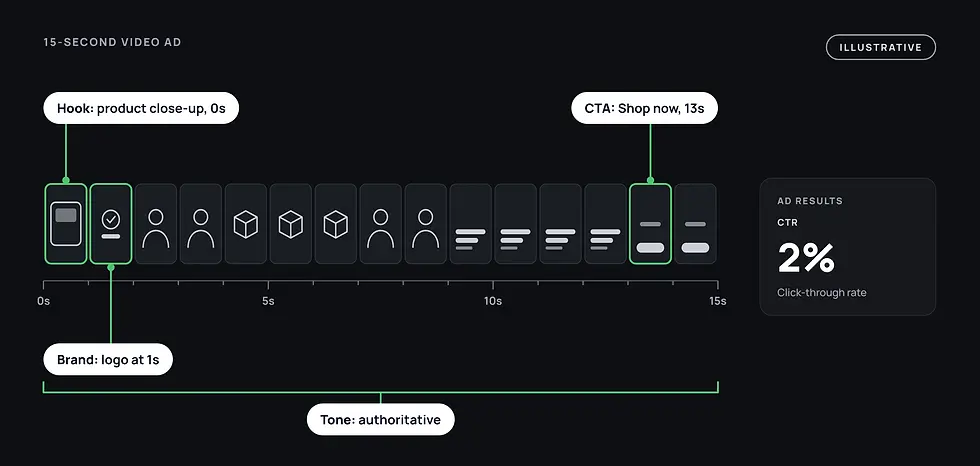
A platform dashboard tells you an ad earned a 2% click-through rate. Creative DNA tells you the ad opened on a product close-up, used an authoritative tone, showed the logo in the first second, and ended on a "Shop now" button. Line those two facts up across hundreds of ads and you can see which choices travel with better results.
Why do generic creative best practices fall short?
Most creative advice is an average across many brands: show the logo early, use people, keep it short, add humor. Some of it will hold for your audience. Some of it will be backwards.
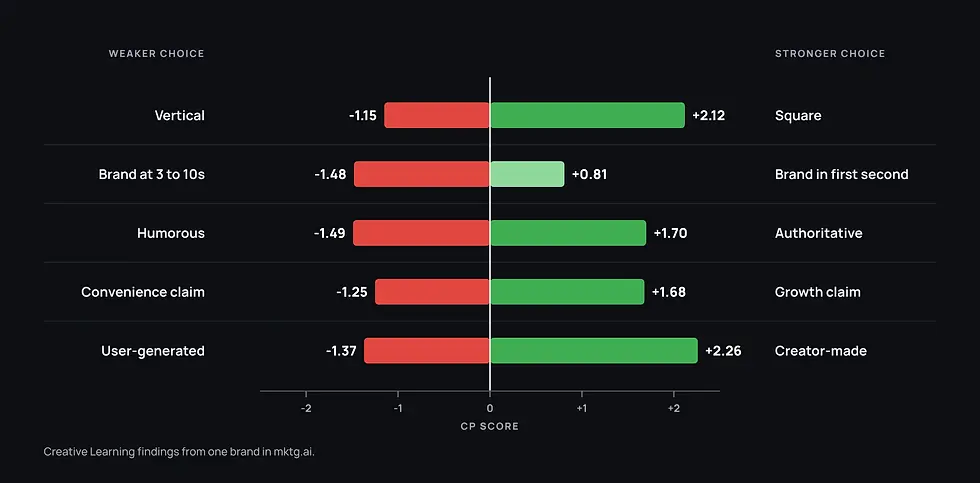
One brand's analysis in mktg.ai found humor scoring -1.49 and an authoritative tone scoring +1.70. A comedy club or a snack brand could see the exact reverse. Neither result is wrong. Each is true for its own audience, and you only find yours by reading your own ads.
What does mktg.ai record about each ad?
Open any asset and click the Creative DNA tab. The top rows cover format, aspect ratio, duration, resolution, language, funnel stage, seasonality, and audio. Below that are 16 groups holding more than 100 attributes. Each carousel slide gets its own profile.
Group | What it tells you |
|---|---|
Hook | What appears first, how clear it is, how long it lasts, and whether there is motion, sound, or text |
Messaging | Copy tone, emotional tone, humor, messaging style, main claim, proof |
Call to Action | Whether there is one, the verb, format, prominence, timing, repetition |
People | Who appears on screen and how |
Product | Whether and how the product is shown |
Brand | How and when the brand shows up |
Visual, Video, Thumbnail | Craft and framing choices |
On-Screen Text | The words inside the creative |
Context and Objects | The setting and what else is in frame |
Offer | Any deal, discount, or incentive |
Interactivity | Interactive mechanics |
Production | Production style, such as creator-made or user-generated |
Compliance | Flags for regulatory or policy concerns |

How do you use Creative DNA on a single ad?
Explain a low score. Open a Very Low ad and check the Hook and Brand groups. A slow open or a late logo is easy to see in the DNA and easy to miss watching the ad once.
Brief from a winner. Open an Excellent ad and copy its hook type, tone, main claim, and call to action timing into the next brief. The designer gets a precise description of what worked, in place of "make it like that one."
Compare two versions. Open two executions of the same idea side by side. The difference in results often traces to one or two choices.
How does Creative DNA connect to performance?
One ad tells a story. Hundreds of ads show a pattern.
Because every ad carries the same profile, mktg.ai can line up each creative choice against Asset Performance Scores. That happens in Run Analysis, under Creative Learning. Real findings from one brand:
Creative choice | Stronger | Weaker |
|---|---|---|
Aspect ratio | Square, APS +2.12 | Vertical, APS -1.15 |
Brand timing | Brand in the first second, +0.81 | Brand at 3 to 10 seconds, -1.48 |
Tone | Authoritative, +1.70 | Humorous, -1.49 |
Main claim | Growth, +1.68 | Convenience, -1.25 |
Production | Creator-made, +2.26 | User-generated, -1.37 |
Example: from DNA findings to a creative brief
Here is how that brand's findings could become the "what we know" section of its next brief. The findings are real. The brief wording is illustrative.
What we know about our audience (last 90 days) 1. Square formats outperform vertical. Deliver square first, vertical as a secondary cut. 2. Show the brand in the first second. 3. Lead with an authoritative voice. Leave humor for tests. 4. Make a growth claim the headline message. 5. Cast creators over customer-shot footage.

Five lines, each backed by a score. A brief like that is harder to argue with and easier to execute.
How much should you trust a Creative DNA pattern?
Creative Learning shows which choices travel with better results. A controlled test shows which choice caused them. Before a pattern goes into a brief, ask:
How many ads is it based on? The aspect ratio finding covered 42 ads. A pattern across four ads is a hunch.
Does it hold in a tighter scope? Filter to one platform and run the analysis again.
Is something else going on? If every vertical ad ran on one weak platform, the platform may be the cause.
Strong patterns go into the brief. Weaker ones go into the test plan.
Try it: write your first three creative rules
In the Creative Library, sort by Best Performance and open your top five ads.
On each, open Hook, Messaging, and Call to Action. Write down what you see.
Repeat for your bottom five.
Circle the choices that show up on one list and rarely on the other.
Those are your first three rules. Run Analysis will test them across every ad in view.
FAQ
What is Creative DNA? The creative choices inside an ad, such as the hook, message, call to action, people, product, and brand timing, recorded the same way for every ad so they can be compared against results.
Does Creative DNA work on carousels? Yes. Each slide in a carousel gets its own Creative DNA profile.
Does a Creative DNA pattern prove what drives performance? It shows which choices go with stronger and weaker results in your own data. Use strong patterns to brief, and test the rest.
Related reading
How to analyze a single ad (post 5)
How to run a creative performance analysis (post 10)
How to turn creative data into a creative decision (post 24)
Learn your own creative rules from your own results. [See Creative DNA in mktg.ai.]


Comments