
How to ask better questions in Ask me


An analyst is only as useful as the question you hand them. That holds for the person down the hall and for Ask me.
Ask "How are our ads doing?" and you get a broad summary. Ask "Which active Instagram ads have a Very Low score and the most spend this month?" and you get a list you can act on before lunch.
The difference comes down to whether the person asking knew what they were trying to decide.
The mktg.ai view: Start from the decision, and the question writes itself.
Here are six habits that sharpen a question, with examples you can copy.
Habit 1: Name the time, the place, and the measure
Good questions say when, where, and by what measure.
Vague | Sharp |
|---|---|
How are our ads doing? | What was our Asset Performance Score on Instagram in the last 30 days? |
What's our best creative? | Show the top 5 paid videos by APS this month. |
Are we wasting money? | Which platform had the most underperforming spend last month? |

Habit 2: Use the words you see in the app
The terms on screen keep a question precise:
APS or Asset Performance for quality
Excellent, Good, Average, Low, Very Low for the bands
Underperforming Spend for budget on weak creative
Awareness, Consideration, Conversion for funnel stages
Image, Video, Carousel and the other format names
Gaining velocity and losing velocity for direction
"Which Very Low ads have the most spend on TikTok?" leaves nothing to interpret.
Habit 3: Start from the decision
Before you type, name the decision. Then ask the question that makes it.
Decision | Question |
|---|---|
What to pause this week | Which active ads have high spend and a Low or Very Low score? |
Where to add budget | Which ads are gaining velocity with below-average spend? |
What to brief next | Which formats have the highest APS across channels this quarter? |
Which channel to trim | Which channel has the largest share of spend in Very Low creative? |
What to tell the CMO | How did Overall APS and Underperforming Spend change from last month? |
Habit 4: Ask for a number of results
"Show the top 5" or "List the worst 10" gives you a shortlist to work through. An open-ended question returns more than a busy week can use.
Habit 5: Ask for the difference
Comparisons tell you more than single numbers.
"How does video compare with carousel on Meta this quarter?"
"Compare Awareness and Conversion APS for the last 90 days."
"On LinkedIn, which performs better: image posts or document posts?"
Habit 6: Leave the answer open
A question that assumes the answer narrows what you can learn. "Why did this ad fail?" presumes a single cause. "What is different about this ad's creative compared with our top performers?" lets the data show you.
Example: rewriting a Monday question
This example is illustrative.
A media lead opens the week with "How did last week go?" Here is how the six habits reshape it:
Name the decision: where to move budget this week.
Add time, place, measure: last 7 days, paid social, APS and spend.
Use app terms and a number: "Show the 5 paid social ads with the most spend and a Low or Very Low score in the last 7 days."
Follow with a difference: "How do those compare with our 5 highest-scoring paid social ads on format and brand timing?"

The first question produced a summary. The last two produce a list to cut and a pattern to fund.
How do you build a question thread?
Strong threads move from broad to specific to action:
Broad: "Which channel had the lowest APS last month?"
Specific: "Show the 5 ads with the most spend on that channel."
Why: "What do those ads have in common?"
Action: "Which ads on that channel are working, so we can move budget to them?"

Four questions take you from a problem to a plan. Start a New chat when the topic changes.
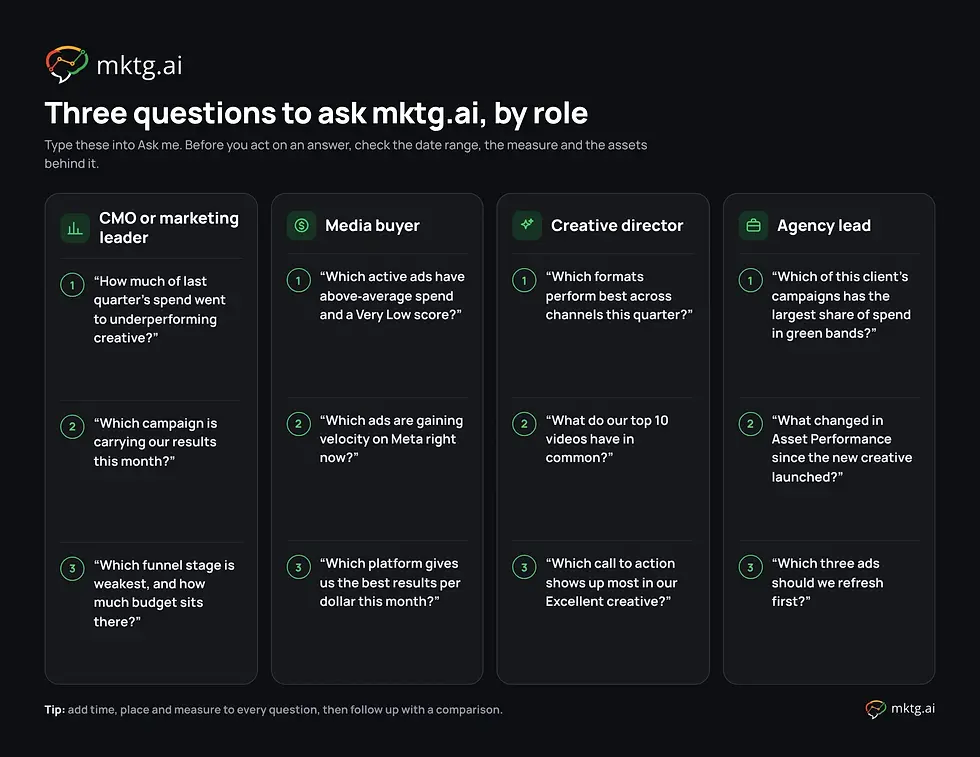
Which questions should each role ask?
Role | Questions |
|---|---|
CMO or marketing leader | How much of last quarter's spend went to underperforming creative? Which campaign is carrying our results this month? Which funnel stage is weakest, and how much budget sits there? |
Media buyer | Which active ads have above-average spend and a Very Low score? Which ads are gaining velocity on Meta right now? Which platform gives us the best results per dollar this month? |
Creative director | Which formats perform best across channels this quarter? What do our top 10 videos have in common? Which call to action shows up most in our Excellent creative? |
Agency lead | Which of this client's campaigns has the largest share of spend in green bands? What changed in Asset Performance since the new creative launched? Which three ads should we refresh first? |
Should you check the answer?
For any decision that moves real budget, yes. Open the ads Ask names and read the score, the KPI it is based on, and the Creative DNA. Good analysts show their work, and this is how you look at it.
When a question gets a useful answer, add it to a shared doc. In a month your team has a set of go-to questions for Monday reviews, campaign check-ins, and creative planning.
FAQ
What are good marketing analytics questions? Questions tied to a decision, with a time period, a channel or campaign, and a measure. For example: "Which active Instagram ads have a Very Low score and the most spend this month?"
How specific should a question be? Specific enough that the answer tells you what to do next. Name the time, the place, the measure, and how many results you want.
Why avoid questions that assume the answer? A question like "Why did this ad fail?" presumes one cause. Asking what is different about the ad lets the data show you.
Related reading
How to use Ask me (post 19)
How to find wasted ad spend (post 16)
How to create a marketing report (post 22)
Better questions, faster decisions. [Try Ask me.]


Comments