
How to turn creative data into a creative decision

"Marketers know creative is underoptimized despite the fact it's a performance driver. They know the feedback loop is broken, but they aren't sure how to fix it."
That is Arielle Feger, senior analyst at EMARKETER, on the April 2026 study that found 3.6% of marketers say creative performance is well understood and actively optimized. (Adweek)
The loop breaks in a predictable place. Teams collect the data. Some find the insight. Then the insight sits in a deck while the next brief gets written from memory, and six months later someone rediscovers the same finding.
The mktg.ai view: An insight that never reaches the next brief is trivia.
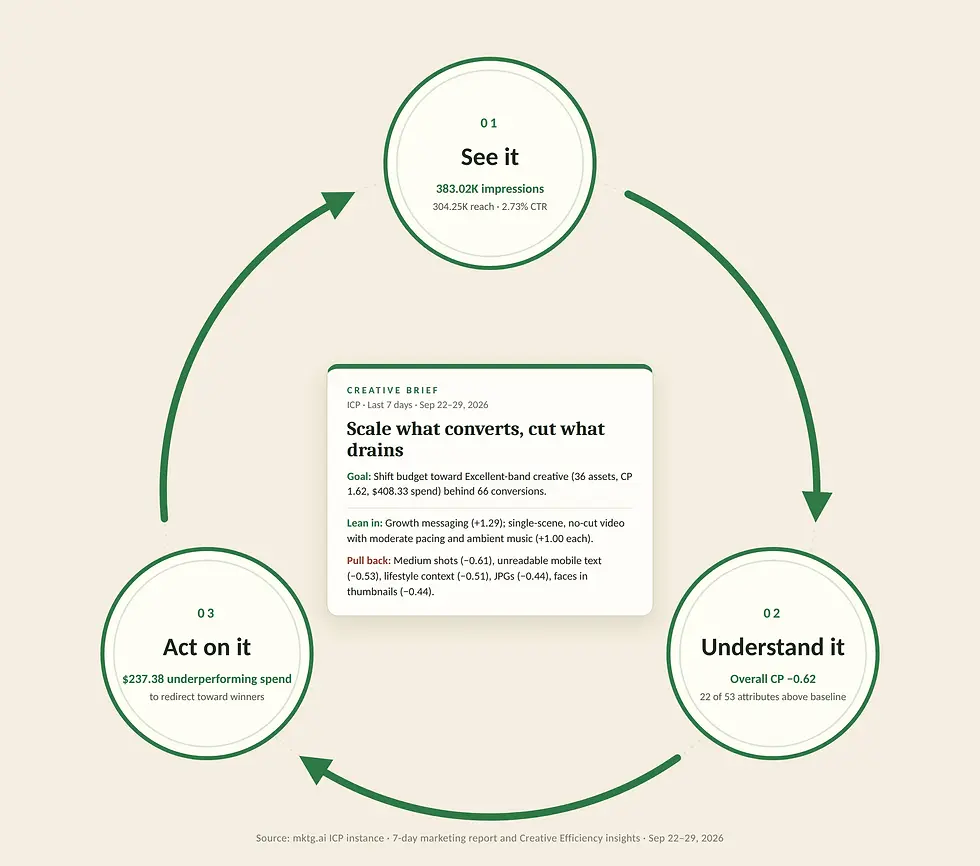
This series has followed one path: see your creative, understand its performance, act on what you learn. This final post joins those steps into a loop your team can run every week, so every finding ends in a decision and every decision feeds the next brief.
Why do creative insights rarely reach the next brief?
Three reasons, and all of them are about handoffs:
The insight arrives late. By the time the report is built, the campaign has moved on and the brief is already out.
The insight has no owner. It lives in a slide. Nobody is assigned to act on it.
The insight has no record. The decision, if one was made, lives in a meeting nobody wrote down.
The loop below fixes each one with a step that has a home in mktg.ai and a clear output.
What is the see it, understand it, act on it loop?

Skip a step and the decision gets weaker. Skip the last one and the loop never closes.
Step 1: What counts as a signal?
Anything that tells you something changed.
Where | Signal |
|---|---|
Daily Alerts | High Spend Low Return, Creative Fatigue, Ad Taking Off, Strong Ad Ending Soon, Top Performing CTA |
Reports | Underperforming Spend up, Overall CP down |
Channels | One platform's Creative Performance slipping |
Campaigns | A red stage in the Customer Journey |
Creative Library | Ads high on Gaining or Losing Velocity |
Run Analysis | A Critical Area in the Summary |
Ask mktg.ai | An answer that surprises you |

Output: one sentence. "Paid social Overall CP fell this month and Underperforming Spend rose."
Step 2: How do you confirm the evidence?
On an alert, open Detail View and read the trigger rules.
On an ad, check Based on to confirm the score uses the right goal.
Open the Metric graph to tell a trend from a one-day blip.
Check the scale: how many ads, and how much spend, sit behind the signal?
Output: yes or no. Is this real, and big enough to act on?
Step 3: How do you find the creative reason?
Set the scope to match the signal: the channel, campaign, or filtered Library view.
Press Run Analysis and open Creative Learning.
Open the top and bottom ads in that scope and read their Creative DNA.
Look for the finding both point to.
Before relying on it, ask three questions. How many ads is it based on? Does it hold on one platform? Is there another obvious cause?
Output: a creative reason. "Vertical ads are scoring well below square ones."
Step 4: How do you make the decision?
Most creative decisions come down to five:
Decision | When |
|---|---|
Pause | Weak creative, real spend, no sign of recovery |
Scale | Strong creative with room for more budget |
Refresh | Good creative that has worn out |
Brief new | A winning pattern your current ads do not use |
Fix the goal | The score uses the wrong KPI |
Write it in one line:

Step 5: How do you act on it?
Budget changes happen in your ad platform.
Creative changes go into a brief, with reference files from Download asset and the Creative DNA details to keep and to change.
Ownership goes on the ad: set the Owner and add the creative team as Followers.
The record goes in Comments, with Send mail to Followers ticked.
Step 6: How do you know it worked?
On the date you set, open the new or changed ads and read their scores. Sort the Library by
Gaining Velocity to see if the new work is picking up. Compare the period before and after the change, as in post 23.
If it worked, the finding goes into your brief template. If it did not, the result is your next signal, and the loop starts again with better information.
A worked example
The Creative Learning figures below are real results from one brand. The scenario around them is illustrative.
See it. Monday's Run Analysis on paid social lists vertical video under Critical Areas.
Confirm it. The Library, filtered to paid social and sorted by Spend, shows several high-spend vertical ads in orange and red, with weeks of consistently low results and the right KPIs.
Understand it. Creative Learning shows square ads at +2.12 and vertical at -1.15 across 42 ads, and branding in the first second at +0.81 against branding at 3 to 10 seconds at -1.48. The weakest vertical ads show late branding in their DNA.
Decide. "Because paid social CP fell, and square with early branding outperforms, we will brief square versions of our three biggest vertical videos with the brand in the first second, owned by the creative lead, checked in two weeks."
Act. Budget on the three vertical videos drops. The brief goes out with the DNA attached. Owners are set.
Check. Two weeks later, the team reads the new scores and compares the two periods.

What does a year of the loop build?
Run the loop every week and something bigger than any single campaign starts to form: a written record of what your audience responds to, built from your own results and attached to the ads themselves. It survives agency changes and team turnover. New hires read it before they spend a dollar.
That is the idea behind the whole series. See your creative. Understand its performance. Act on what you learn. Then do it again, a little smarter each time.
FAQ
What is creative performance optimization? The ongoing work of using performance data to decide which creative to pause, scale, refresh, or brief next, and checking whether those decisions paid off.
How often should a team run the loop? Weekly works well while campaigns are live, with a monthly pass over a longer window for Creative Learning.
What if a creative decision does not work? Record the result. It becomes the next signal, and the loop starts again with better information.
Related reading
How to run a creative performance analysis (post 10)
How to act on a performance alert (post 15)
How to get started with mktg.ai (post 1)
Close the loop between what you learn and what you make next. [Book a demo of mktg.ai.]


Comments