
What Is Performance Creative?

Performance creative is advertising creative that is built to hit a number and judged on whether it did.
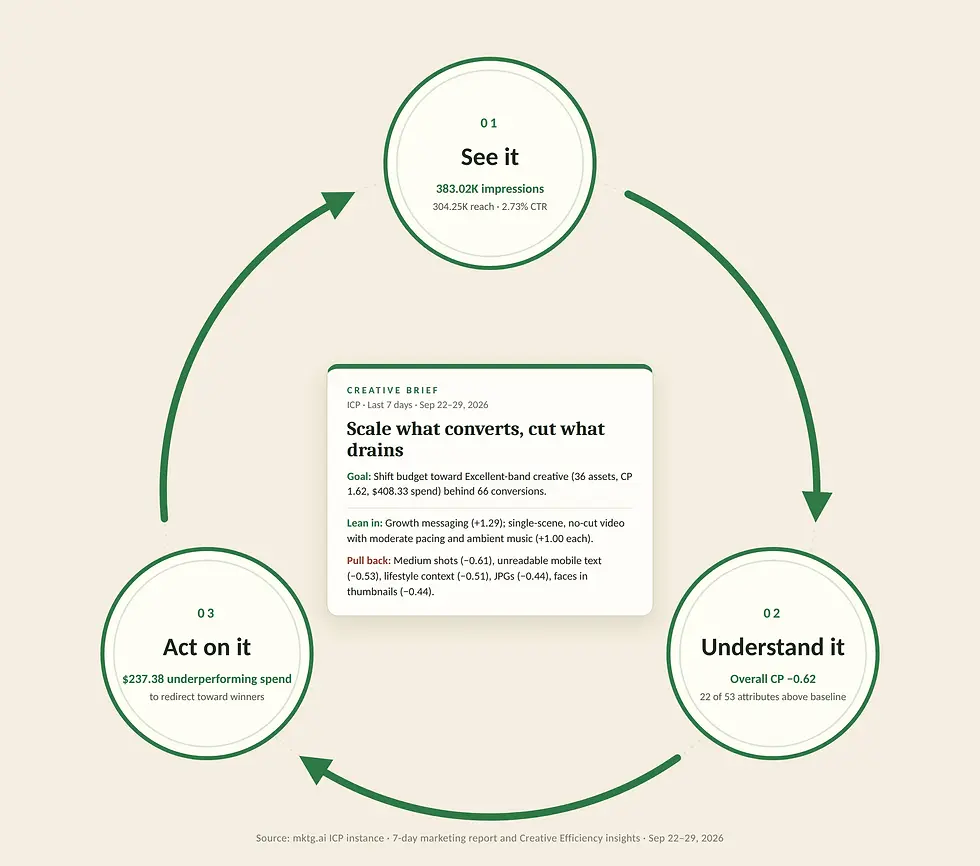
A traditional creative process ends at delivery. The work gets approved, it ships, and the team moves to the next brief. Performance creative keeps going after delivery. The ads run, the results come back, and what the results say goes into the next round of work. The creative team and the media team read the same report.
That is the whole idea. Everything else is how you do it.
Why creative carries so much of the result
NCSolutions studied nearly 450 CPG campaigns across TV and digital and split ad-driven sales lift into five drivers. Creative accounted for 49% of it. Brand came next at 21%, then reach at 14%, targeting at 11%, and recency at 5%.
Half the outcome sits inside the asset. Most measurement budgets sit everywhere else.
That gap is why performance creative exists as a practice. Media teams have had granular feedback for twenty years. They know which placement, which audience, which bid, by the hour. Creative teams have had a monthly deck that ranks ads by result and explains nothing about why.
For more on what that gap costs, see Half the Money I Spend on Advertising Is Wasted.
Strategy: deciding what to make
Performance creative strategy starts by writing down what you believe before you spend anything.
A usable brief for this kind of work names four things:
The number the work has to move
The specific claim or idea being tested
What you expect to happen, written down in advance
What result would make you stop
Most briefs name an audience and a tone and stop there. Neither of those is testable, so neither teaches you anything when the results come in.
The second half of strategy is coverage. One idea executed five ways tells you about executions. Five different ideas tells you about ideas. TikTok's own guidance for performance ads is 3 to 5 creatives per ad group across 3 to 5 diversified ad groups, and it says outright that creatives with big differences between them beat small variations.
Spread the bets across things that could plausibly be true, then let the market pick the winner.
Production: making enough of it
Performance creative needs volume, and volume is a production problem before it is a creative problem.
Three things make volume possible:
A modular build. Shoot and design so hooks, claims, endframes and backgrounds can be recombined without a reshoot.
A naming system. If you cannot tell which version is which from the file name, you will not be able to read the results later.
A standing schedule. Creative refresh happens when it is a calendar item with an owner.
Platform specs belong in production planning rather than at the end of it. TikTok asks for 9:16 vertical at 720p or better, with the hook in the first 6 seconds and the content proposition inside the first 3.
Google's ABCD framework for video asks for four things. Attention: hook and sustain it with an immersive story. Branding: brand early, often and richly. Connection: help people think or feel something. Direction: ask them to take an action. Google reports that following the framework can deliver as much as a 30% lift in short-term sales likelihood and a 17% lift in long-term brand contribution.
Those are the platforms publishing what they reward. Build to it.
Measurement: reading what came back
This is where most performance creative programs fall apart.
Every platform will tell you that an ad performed. Almost none of them will tell you which part of it did the work.
Measuring creative takes three things:
A consistent way to describe the asset. Every ad broken into the same set of elements: hook type, opening shot, who appears, the claim, the offer, pacing, endframe, format, length. The same vocabulary every time.
Performance joined to those elements rather than to the campaign. Campaign-level results tell you which ad won. Element-level results tell you what to make next.
Enough volume for the comparison to mean something. Two ads is an anecdote.
With those in place the useful questions become askable. Does the problem-first hook beat the product-first hook on TikTok and lose on LinkedIn? Does the offer endframe lift conversion while costing you view rate? Is the 15 second cut carrying the 30?
The full method is in Creative Performance Measurement: The Complete Guide. The systems that do this automatically are covered in What Is Creative Intelligence? A Plain-English Guide, and the data plumbing underneath it is in The Data Substrate Matters.
What changes across channels
The principles hold everywhere. The specifics do not.
Each channel has its own creative conventions and its own reporting vocabulary, and that second part is the practical problem. An element that matters on TikTok may be invisible in the Google reporting and named something different again in the LinkedIn export. Comparing creative across TikTok, Meta, Google, LinkedIn and The Trade Desk means putting every asset into one shared vocabulary first, then joining performance to that.
Teams that skip this step end up with five channel reports and no way to answer a question that spans them.
Five ways this goes wrong
Testing executions when you meant to test ideas
Changing more than one thing at a time, so no result can be attributed
Calling a winner on three days of data
No shared vocabulary between the creative team and the media team, so the learning never transfers
Findings that live in a deck nobody opens before the next brief gets written
Where mktg.ai fits
mktg.ai reads the creative you have live and connects performance to the elements inside each asset, so the next brief gets written from evidence rather than instinct. It covers TikTok, Meta, Google, LinkedIn and The Trade Desk, so the comparison holds across channels instead of stopping at the edge of each one.
If you are evaluating options, The Best Creative Analytics Tools in 2026, Compared covers the category.
Frequently asked questions
What is performance creative?
Creative that is built against a specific number and judged on whether it moved that number. The defining feature is the loop: results from the ads that ran feed the brief for the ads that get made next.
How is performance creative different from brand creative?
Brand creative is judged on what it does to how people think about a company, measured over months. Performance creative is judged on what it does to a number, measured over days or weeks. Most teams run both, and a single asset often serves both purposes. The difference sits in how the work is briefed and how it gets judged.
What makes a good performance creative brief?
It names the metric, the idea being tested, the expected outcome written down before launch, and the condition that would make you stop. A brief that names only an audience and a tone cannot be proved right or wrong.
How many creatives do I need to test?
Enough to separate ideas from executions. TikTok recommends 3 to 5 creatives per ad group across 3 to 5 diversified ad groups on its own platform. The deeper requirement is variation big enough to read: several versions of the same idea tell you about craft, while several different ideas tell you which idea works.
How long should a creative test run?
Long enough for the result to survive the day it was measured on. Daily swings in delivery, audience and auction pricing mean a three-day read is usually noise. Let it run through at least one full weekly cycle before acting on it.
Who owns performance creative, the creative team or the media team?
Both, which is why it fails so often. The practice works when the two teams share one vocabulary for describing an asset and one report they both trust. Where ownership is split and the vocabulary is not shared, findings stop at the team boundary.
What metrics measure creative performance?
Start with the metric the business cares about, usually cost per acquisition or return on ad spend. Add diagnostic metrics that show where an ad is losing people: hook rate or 3 second view rate for the opening, hold rate or completion for the middle, click-through and conversion rate for the end. The diagnostics tell you which part to fix.
Does performance creative mean making lower quality ads?
No. Volume and craft are separate dials. Modular production exists so more versions can be made from the same high-quality shoot, rather than so each version can be made more cheaply.
Want to see which elements of your creative are driving performance? Book a demo.

Comments